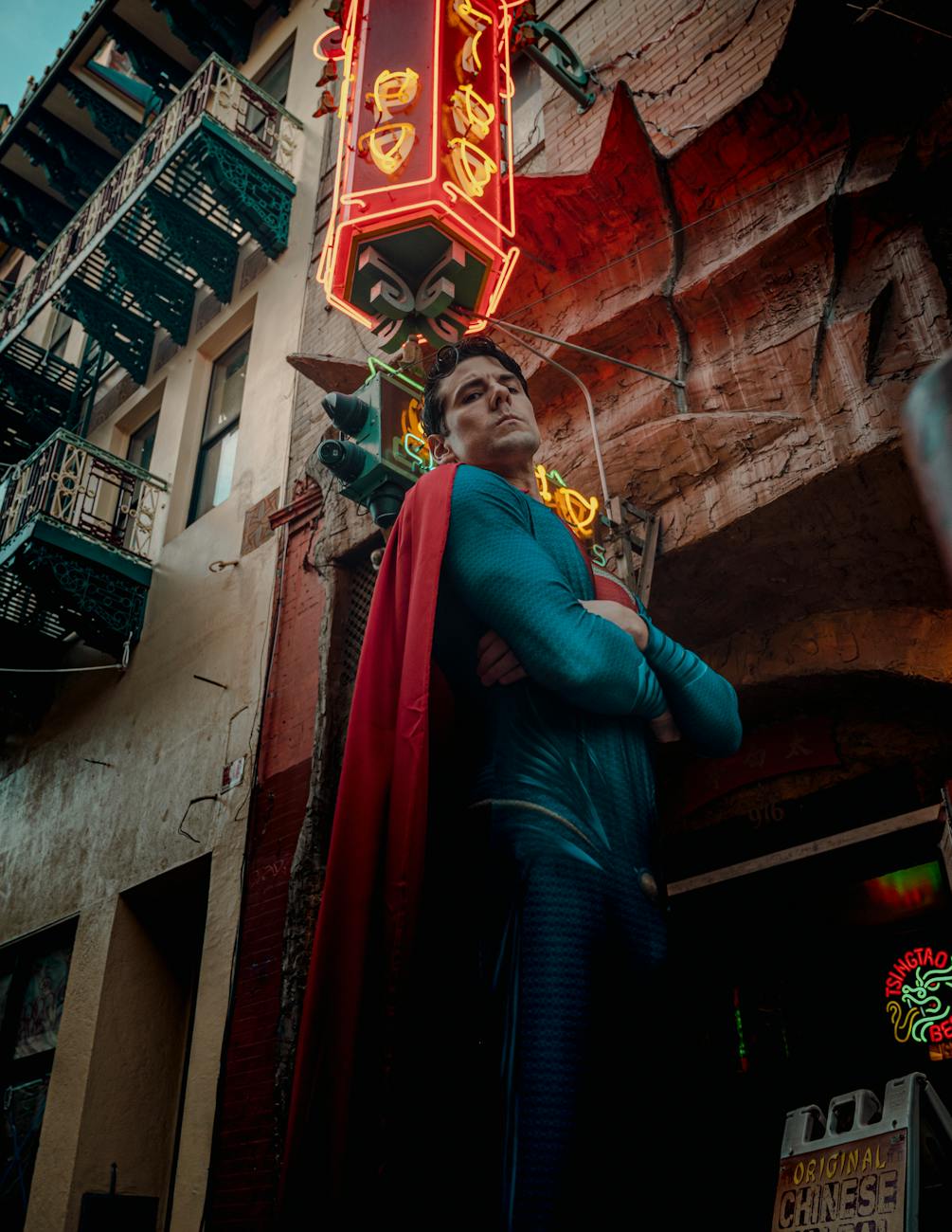
Much of the #veryonline discourse in recent weeks around James Gunn’s new Superman movie has centered on whether Superman is an immigrant or not. As far as I’m concerned, there is no debate as to Superman’s “immigration status.” Born on another planet, the character is an alien; he takes being an immigrant to a new level. But, even if the character’s fictional history is set aside, the historical context for the publication of Superman comics provides an unsurprising connection between Superman and immigration. Superman’s creators, Jerry Seigel and Joel Schuster, were both children of Jewish immigrants. Immigration, then, is baked into Superman, both the character and the comics (sort of like the United States?). None of this is in question, nor is it new. The immigration and “woke” controversy is certainly not about Superman’s “immigration status”—Superman is a fictional character, after all. The real problem is what Superman means for the United States in 2025. In a country that can’t agree on what “the American Way” means anymore—or what it’s supposed to mean, whether Superman is “one of us” or “one of them” is a fraught subject.
In addition to the immigration or “woke” question, what I’ve seen online is commentary that people either love the new movie or hate it—no in between. For me, watching it this past weekend felt very much like reading a comic book, so my experience of seeing it felt familiar and comforting. If I hadn’t grown up reading comic books, however, I might not have liked it as much–or at all. I suspect that without my own personal history, I would have preferred a story more like Christopher Nolan’s Batman films or even Zack Snyder’s Man of Steel. These movies insisted on a personal and societal darkness that seems, well, more realistic. The heroes of these movies were heroic because they triumphed in spite of living in, and being part of, that gray world. Henry Cavill’s Superman, after all, kills–even if he does it to save a family (the American family?). He does it because he has no other choice. In the new movie, David Corenswet’s Superman would find a way out of that situation, which is probably right (here I mean that it would be more comics accurate and, generally, in line with the ethos of Superman). For fans of comics accuracy (in feel if not strictly speaking storyline), I think the movie is a big hit. For fans of a more complicated view of the world, I’m sure the movie falls short.
Heaven is boring, and perfection is boring, which is why there’s a me in another universe probably hating this new movie. The excitement in a Superman movie is seeing how Superman wins the day, not if he wins the day. You go to watch how, despite impossible odds, he beats the bad guy, saves the city, and saves the girl. That gets old. And, that is where, given our historical moment, this movie falls short for me. It is true that Superman comics emerged in a world living through a catastrophe, the Second World War. Mass horror was much closer to people, to Americans, than now (mass horror exists now, but you can either tune it out or view that horror through a political lens that evacuates the humanity from the horror). So, in some ways, the optimism and hope baked into Superman is a little preposterous—except that after the end of WWII, there seemed to be signs of, if not progress, then the curtailment of mass murder. There was room for hope.
But we are living in a world submerged in mass murder, a world in which injustice is expanding, not receding; we are staring at the precipice of annihilation, not seeing signs of hope in the stars.
As a cultural testament of hope, the movie has much to recommend it. As basic as it might seem, we seem to be in dire need of stories of kindness these days. That said, this story makes me uneasy. Putting aside the affirmative character of culture argument, that movies (of any stripe) can, by entertaining us, reduce the public’s urgency to right wrongs all around us, the text I am inclined to think through this latest iteration of Superman is Don Quijote. In this new movie, Superman lets Lois Lane interview him after she points out that his self-interviews (as Clark) are not very…journalistic. In that interview, Lois’ questions reveal what I would call a healthy skepticism regarding Superman’s unrestrained and muscular will to help without thinking about consequences. The audience doesn’t have to worry that Superman will make the world a worse place, but without the pre-textual guarantee of his goodness, Superman’s approach could be called chaotic good, kingly, even authoritarian. So, Lois has a point. But, what her questioning specifically highlights is that Superman doesn’t take into account either the context or the consequences of his actions—and that his power to restrain bad actors rests on the threat of violence, torture, or possibly even murder (in this way, his power is much like the power of the State).
From Clark Kent’s perspective, Superman is doing good and saving lives. His take is, basically, that regardless of the consequences, the important thing is the preservation of life. And that Superman will deal with the consequences of his actions when and if they emerge. Not completely batshit in a bilateral world, but in a multilateral world? Especially one in which the enemy can be trolls on the internet, a billionaire evil mastermind, another country bent on conquest, or all of the above. The likelihood of batshit goes way up. The distinction (almost opposition), then, in this movie between unrestrained, chaotic good and nuance and legality is what has me thinking (yet again) thinking of Don Quijote.
As that novel’s narrator makes plain from the beginning and throughout both volumes of the novel, Don Quijote is suffering from a mass delusion. He experiences the world through his reading of novels of chivalry, his imagination transforming inns into castles and prostitutes into highborn ladies. This means that Don Quijote goes through the countryside saying and doing foolish things. Some people treat him as a kook. Some people try to swindle him. Most people end up beating him up (yes, really). One of the many, many foolish things he does is free a number of galley slaves being taken to prison. Don Quijote reasons (yup, reasons) that every rational being wants to be free and that everyone deserves freedom (a simplistic but not wrong way to think about freedom through Early Modern political theory), so he frees them all without care as to what they have done to land themselves in prison and enslavement. If we put aside the notion of punishment baked into the criminal justice system (then and now), a reasonable question that will come up regarding this notion of unrestrained freedom is what happens to the victims of crime and their families. How is their harm ameliorated? What kind of repair is available to them if those responsible for crimes are let go? I imagine that, like Superman, Don Quijote would say that that is a problem to deal with later.
The thing is that Don Quijote is not wrong. Superman is not wrong. Everyone wants freedom or has the desire to get to choose what to do, where to go, how to live. Nobody wants to be enslaved or incarcerated. Likewise, it makes no sense for Superman to let the people of a country die in an invasion as he weighs the political repercussions of intervening when he could just as easily stop that invasion, prevent death (which is what he does). Worry about the legalities later.
In his interview with Lois, Superman asserts that “kindness is punk rock.” My problem is that I don’t know how, in our times, kindness without strategy can be helpful. Everyone deserves kindness, but in this world, it behooves us to notice who we elevate and amplify and who we have to humanely and respectfully hold accountable for their actions and misdeeds. I’ve seen people try to kill others with kindness…I’ve never seen that transform anyone into a good person or even stop them from behaving badly. At most, I’ve seen a grudging stalemate—but only when whoever is doing the “killing” has blocked the ability of the other person to do them further harm.
So, my critique here is that the movie is out of sync with the world we live in—and not in a delightfully hopeful way. Kindness is important, and it should guide how we live. On a global scale, however, kindness seems to be a memory, and if it ever truly existed, it may come again. But I see none of it now, and I’m not sure that kindness alone will defeat the truly awful things to which we bear witness all the time. Here’s another way of saying what I’m saying: Superman presents a clear and unflinching moral vision. Lois is questioning him based on legality, context, and the correctness of minute decisions, regardless of results. Superman is not arguing that the ends justify the means per se…but he gets uncomfortably close to it.
The thing is, most of us live in the crevices of legality, not in the halls of grand moral gestures. We can’t ignore the repercussions of the actions that we take in a particular moment, even if it’s the most moral action or decision for the situation unfolding in front of us in real time. I have personally been in situations in which I was either being verbally attacked or threatened because of my sexuality. The right thing, the pure thing to do would have been to stand up for myself and call out how unfairly I was being treated. That would have also led to my being physically assaulted or worse. The thing is that this situation, as common as it might be, is actually clearer than a lot of situations we’re in every day. Of course, I want to root for Superman’s (and Don Quijote’s) perspective. He’s not wrong. I just don’t know how we’re supposed to live like that—especially now. Of course, especially now is probably when it is most critical to think and act like Superman. It’s just that a lot of us will have to die before behaving like that starts to mean anything. Then again, it looks like a lot of us are going to die anyway.
You probably think I’m being paranoid for saying that, and you’d be right. At the same time, I’m not wrong either.
Behind the debate as to whether Superman is an immigrant or not lies the question of who gets to decide who an American is. That has always been a question central to the American experiment. To this question, “who is an American?”, Gunn’s Superman‘s naive yet elegant response is: be kind. We have to take that approach seriously, but we also have to think about kindness as a way of being in the world and also as a way to signal strength. We could argue that this is what this Superman is doing, but I don’t think so. Gunn’s Superman is advocating kindness through the threat of violence (a benign violence, a holy violence, but violence nonetheless). That is not what I mean when I’m trying to pair kindness with strength. I’m thinking more along the lines of Sor Juana, who in La respuesta a Sor Filotea once wrote that knowledge in the wrong hands is like a sword, causing death and destruction, when it’s really the noblest instrument for defense. I’m asking, then, how can we mobilize kindness such that it permeates our world and provides protection and defense when we have been taught to think of it as weakness? How can we use it to facilitate connection and use it as a shield for those who need it? This is a sincere question. I really want to know.
 Javier Jiménez Westerman, PhD
Leave a comment