Education is transformational–or, so we believe. That message is everywhere. Bonafide, real-life heroes tell us so.
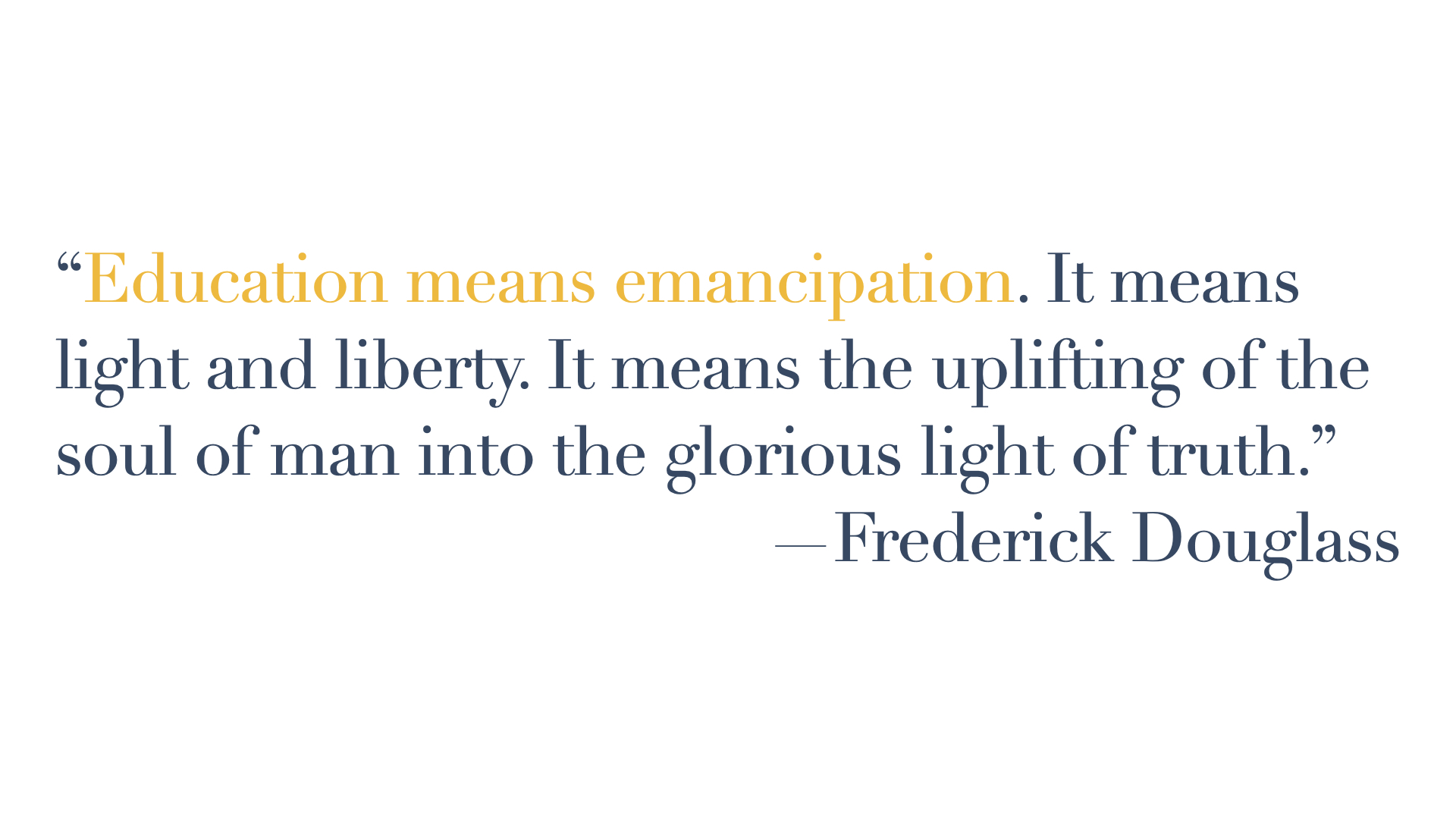
And, as far as I’m concerned, education is transformational. My life is evidence of that truism.
But, is that true for everyone?
After all, when I teach college students, I often tell them that I’m about to ruin their lives; my job is to expose them to the complexity of the world. For example, I’ve often made the case that, in The Little Mermaid, Ursula is right when she goes full sea witch–because Ariel signs a binding contract and then breaks it. When I make this argument, I can almost see my students’ hearts breaking. Sometimes, knowledge hurts.
We know that schooling is strongly correlated with a country’s GDP worldwide.
We also know that in the United States a college degree can make a significant difference in income from one generation to another. In other words, people with college degrees tend to make more money than their parents (who did not have a college degree).

So, education certainly plays a role in social and economic mobility.
Education also plays a role in human development. It is one of three dimensions that make up the Human Development Index (HDI), a statistical measure created by the United Nations Development Programme “to emphasize that people and their capabilities should be the ultimate criteria for assessing the development of a country, not economic growth alone.”

And yet, is “human development” a good proxy for education as transformational and emancipatory?
What might better capture education as transformational? What does “transformational” even mean?
By transformational, I mean, as ancient philosophers might have, whether education can lead us to a good life. Is education the path to nirvana?
Gallup and the Wellbeing for Planet Earth (WPE) Foundation argue that “individuals’ subjective experiences and their own sense of how well they live life also matter.”

In other words, looking at GDP and social mobility–even HDI–is not enough to get a comprehensive sense of an individual or a society’s wellbeing. The principles of harmonic wellbeing (contentment, inner peace, harmony, and balance) are also important.
So, how does wellbeing factor into my original question, is education transformational?
As I suggest above, if the question is whether education leads to the good life or to nirvana, then this question is (also) about the relationship between education and wellbeing.
According to Gallup/WPE, people across the world regularly have experiences that are linked to the different indicators for contentment, inner peace, harmony, and balance–the four dimensions of the harmonic principles of wellbeing.

But, how does education factor into harmonic wellbeing? Well, it turns out, quite strongly.
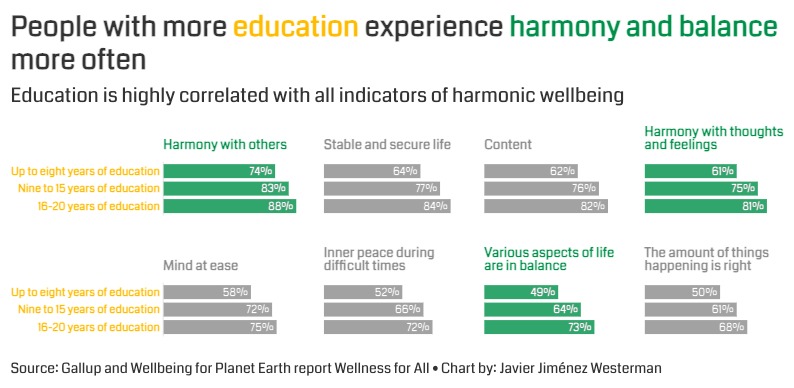
Indeed, it is clear that education is an important factor in the dimensions of harmonic wellbeing, especially as it relates to harmony.

So, the truism is correct: education promotes wellbeing, and returning to my original question, it looks like education can be transformational for people all over the world. The key, then, must be to educate the world. The more educated the world is, the more likely we will all be vibrating in the same harmonic frequency, chakras aligned, ready to transcend. Right? Not so fast.
Education writ large is not the issue. Rather, the uneven and unequal access to a quality education across the world is. We see the stratification and agglomeration of educational resources and opportunities in which those who stand to benefit the most are least likely to have access to them both domestically (in every country) and internationally (from richer to poorer countries).

It is true that people who are more likely to experience harmony and balance tend to be more educated–and tend to live in richer countries. Harmony and balance are by no means experienced more in richer countries, but people in richer countries can satisfy their basic needs more reliably. It is easier to be in harmony with yourself and others when you’re worrying about sending your children to the “right” school–not worrying about whether you can send them to school at all. Likewise, it is easier to learn when you’re not worried about where your next meal is coming from. Free and reduced-cost breakfast and lunches in U.S. public schools are available because it’s easier to learn when your stomach isn’t twisted up in knots from hunger.
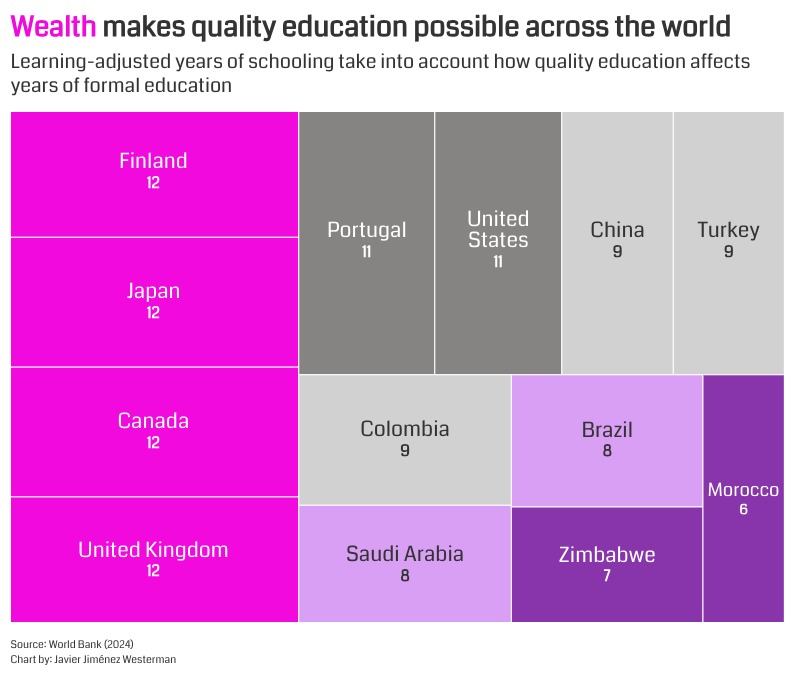
If education can help us reach nirvana and get all of our chakras to vibrate in the same universal frequency (that’s not a thing, I’m just being dramatic), the solution is not “more” education but rather quality education, an education through which we can learn marketable skills and discover what gifts we have to offer to the world. This is as much an issue of funding as it is an issue of equality, equity, and human dignity.
Education has been transformational in my life–because I have had the privilege of a quality education (despite not being from the “right” neighborhood or background). Through personal effort, blessings from the ancestors, and serendipity, I was able to access amazing educational opportunities–at an Ivy League institution as well as perhaps the best public university in the world. That education sparked habits of mind and conceptual knowledge that helped me to develop professionally and personally in a way that is reciprocal and iterative. That is, I was able to enter a professional world in which I could use my skills productively, leaving me with the time and space for introspection and personal growth. My education also gave me the tools to engage meaningfully with my personal growth and purpose in life. In turn, that introspection and refining of values have always enhanced how I understand and progress through my professional world. What would it take to make this kind of educational journey available to all who want to pursue it?
 Javier Jiménez Westerman, PhD